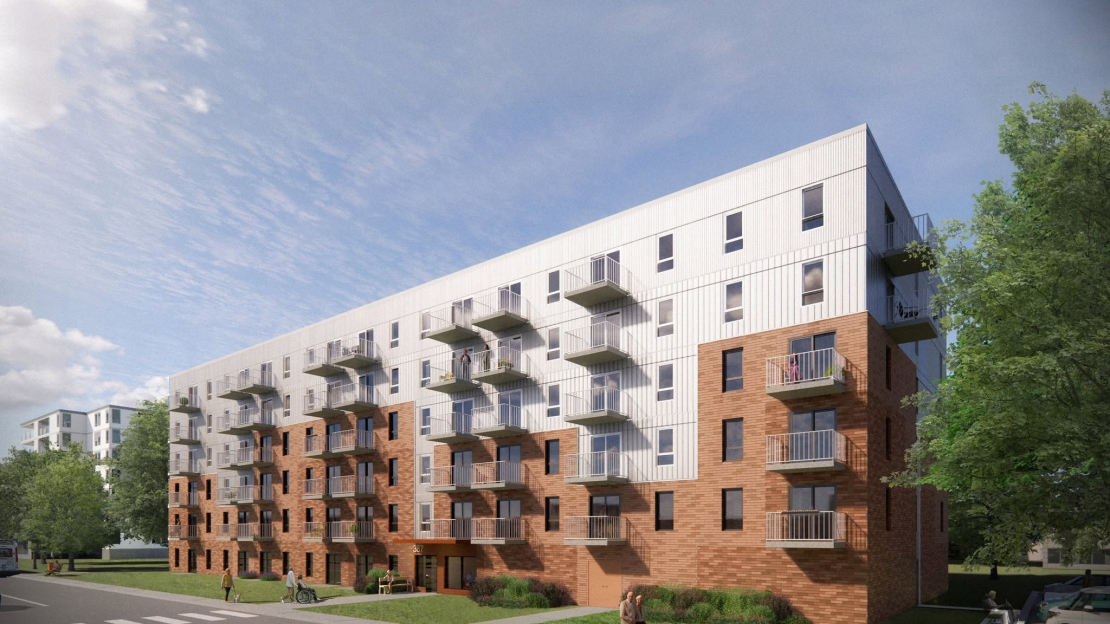
Twenty buildings of 100 units each, under construction across Quebec since 2023, about a dozen already delivered, with not a single cost overrun and 35 to 40% below going prices, according to their founder. Luc Maurice runs Mission Unitaînés on a method that fits in three words: repetition, rigour, trust. A conversation about the price of regulation, the culture of construction, and what the industry could take from it.
An interview from our Vision et visionnaires series, devoted to organizations that think differently about residential construction in Quebec. Luc Maurice founded Groupe Maurice, then Mission Unitaînés, a social housing project for low-income seniors carried out with all three levels of government. Interview by Chantal Lapointe.
From Groupe Maurice to Mission Unitaînés
You built Groupe Maurice. What convinced you to take on social housing for seniors?
For 30 years, I housed older people in Groupe Maurice residences. Every month, people came to see me. They dreamed of moving in with us. Their sister lived there, their cousin, their best friend, a former colleague, their neighbour. But they couldn't afford it.
It broke my heart. It was happening even to people close to me. That was the trigger. I kept telling myself that the day I had the means, the day the opportunity opened up, I would act.
Did the governments have reservations? Did they warn you that your timelines weren't realistic?
All three levels of government showed remarkable drive. Everything moved forward, with cooperation and enthusiasm.
Getting governments at different levels, with different approaches, to work together this closely is a real feat. Trust carried everything. I bet on boldness, and so did they. I want to stress that. Everyone grasped the urgency. Everyone put numbers on the costs, and on the savings that speed of execution produced. In short, they saw the benefits of the model.
Which project did you deliver first?
Shawinigan, then Granby. We have twenty. About a dozen are delivered; the rest will follow this year. Three projects have just been awarded: work is barely starting. Even so, everything will be finished in 2027. We will have delivered 2,000 housing units, spread across almost all of Quebec, at a rare pace.
Do you plan to continue Unitaînés?
That decision isn't mine. The different levels of government will decide in due course. Seven sites are still under construction. And we are doing this because there is a pressing need among people with no pension at all, who get by on a minimum government income of less than $2,000 a month. No one can live on that. Add $1,500 in rent: the math collapses.
You went from 1,000 units to 2,000. What does that kind of scale-up change?
Since we repeat the same building, growth works in our favour. It lets us optimize and share all our tricks even more. I should point out that the project has two phases: the three recent projects are simply added to phase 2.
Repeating the same building, a choice for society
You repeat the same building from one town to the next. Why bet on standardization?
Two key words sum up my answer: accessibility and affordability.
The crisis is hitting now. We need housing now, not in ten years. Same thing for long-term care homes (CHSLD): the need is urgent. So accessibility weighs heavily in the decisions, and the standardized model answers it. This model makes the most of resources and reaches formidable efficiency, without sacrificing the human side, quality or safety. Why look for something else? The formula works, so let's apply it. The idea isn't new: think of the post-war houses.
And finally, present a well-thought-out, well-polished, clearly defined product, and the general contractor knows exactly what they are signing up for. They worry less, question less, optimize more. The result: we build much cheaper and much faster.
If standardization speeds up construction and squeezes costs, why has the industry shunned it for the past twenty-five years?
I won't comment on what hasn't been done. I saw the urgency and I believed I could answer it. Building a lot with limited means, and our means are still limited, requires innovating and finding more economical ways of doing things.
Of course, having it all is appealing. Building perfect, risk-free, flawless buildings with spectacular common areas is appealing. But that approach has you build a single one, and it serves 100 people. A more modest version, though very well thought out, serves two or three times as many. The math is obvious. It's a choice for society.
Affordability matters a great deal. The work still has to be done, because society gives it little thought. One example: cut the construction cost of a rental building by 10%, and you lower the tenant's rent by nearly $200 without touching the developer's profitability. Better still, a much lower rent reduces their business risk, since it attracts more tenants looking for a better price.
Too often, we put too little emphasis on discipline and on the effort to get the best price, even if it means letting go of a piece of land, a business relationship or an opportunity that would force us to charge too much. So it's up to us, as a society, as a team, as experts, to think about this affordability component and to act. It was at the heart of Mission Unitaînés, and we showed that it was one of the keys.
The building code and the price of each requirement
Every two or three years, the building code raises a requirement. Do you question it?
Recently, people were calling for buildings much more resistant to earthquakes. In Vancouver, the requirement makes sense: the city sits on a seismic fault. But is it just as crucial in Montreal? I've been in this business for 30 years. Concrete columns and structures have gained four inches in 30 years. Fine. But it costs.
Some requirements deserve to be raised, but we are always weighing risk, comfort and cost. We weigh them as families, we weigh them at every scale. We weigh them everywhere, except sometimes at the scale of the community. And that's where it gets tricky: at the end of the day, every government decision should weigh not only what it gives a person, but also what it costs them.
I'm not questioning the code. Instead, I strongly urge the federal, provincial and municipal authorities to form a committee and look for ways to save, to design the simplest possible building while preserving safety. We all recognize how important that is. But regulating everything the same way, generalizing, standardizing everywhere: that costs more, no doubt about it.
Overruns that are nothing like fate
The industry lives with overruns so routine that everyone expects them. Does your model change that?
The construction culture doesn't have to accept overruns as inevitable. Prepare well, organize well, execute with rigour: the overruns disappear.
We proved it on 20 buildings. No overruns. We even generated savings. Why are we beyond 10% in savings? Because we built trust and cooperation across the whole group. When a contractor landed an excellent price from one subcontractor and good service from another, I would go see them and ask permission to share those names, those contacts, with other general contractors who were struggling in this or that area.
There's team spirit, the work is done well and thought through well, the project managers plan properly ahead of time: we avoid surprises and we move forward. Still, the resources have to be there. Without an electrician when you need one, you hit a problem. Under those conditions, you don't launch a project. Before starting anything at all, everything has to be properly in place. That's risk management. Construction is risk management.
Did the culture of construction shift between before and after the pandemic?
Three or four years before the pandemic, people took great pride in staying within their construction costs. Surprises happened sometimes. Some people miscalculated: a lack of rigour. And accidents happened. They do. But in general, people held to their costs. They renegotiated with all their subcontractors, worked evenings and nights. We managed.
During the pandemic, and after it, the whole approach to risk shifted. For a few years, contractors refused fixed prices and asked for a project-manager role instead. They would build the building, manage the subcontractors and keep the site running, but they would guarantee no price. A good idea of the price, with no guarantee.
That shift also drove construction costs up. Inevitably: as soon as you stop pushing down the bill with every subcontractor and every supplier, the equation changes. On top of that, countless projects started at the same time, while skilled, experienced labour was in short supply. So the contractor has to rein in their appetite and deliver what they promised to deliver. All of this can easily push construction costs up by 10, 20 or 30%. And all of a sudden, your project's economics collapse and you're in trouble.
What allowed you to stay on budget and on schedule?
No surprises. No surprises. The same product, repeated. Repeat the same product, give each general contractor between four and six of them, and the second time they do exactly the same thing. What worked the first time, they repeat, then they adjust the recipe a little for the next ones.
Add speed. At Groupe Maurice, setting Mission Unitaînés aside for a moment, we saved a month of construction on every new complex, every new private seniors' residence (RPA). That's worth $520,000. It's huge, $520,000. And every million saved on construction lowers people's rent by as much. The impact goes straight to the person.
For Mission Unitaînés, I'd say rather between three and six buildings per contractor: twenty buildings of 100 units each.
Did you put those savings into lower rents?
Into accessibility. We gave the government one and a half more buildings, free of charge. So once the whole thing is finished, we will have delivered 150 more units than promised, without a cent more.
What obstacles did you run into? Labour? Materials?
No, I don't share your view. During the pandemic, the difficulty was less the quantity of materials than their availability. That set off incredible inflation. Today, things have stabilized. The level of construction in Canada has held roughly steady for a year: you can shop around.
Make the effort, make the calls. Know how to say no, too. Someone offers you a price; you always have the choice to turn it down. When the industry overheats, people neglect price. They just want to build. They have a contract, they deliver what they have to deliver, and they hand you the extra bill. Think it through. Rigour also means spotting overheating, and its absence. If you charge ahead despite overheating, you take on extra risk and your chances of staying within your costs melt away.
Rigour isn't only the government's job
After a whole life in the field, what major challenges lie ahead for the industry?
I won't analyze every challenge. What concerns me is affordability, and how to make it a priority: in government as in the construction culture, among suppliers, in training, and in trust as well.
We aimed to pay our general contractors within two weeks. No one in construction paid them in two weeks. The delays often stretch much longer: three, four, five months. Building trust matters enormously. When someone knows you respect them and that you are helping them succeed, they sharpen their pencil a lot more. Trust isn't about words. It comes through actions. It comes through money, and through the absence of surprises on both sides.
What would you like governments to put in place?
The government won't act alone. We keep up this culture of always blaming it. The responsibility goes beyond it. It plays its role, but the industry's culture matters just as much.
You, the developers: you want a project so badly that you pay an exorbitant price for the land, then you close your financing, your analysis and your marketing, and the project no longer holds up. You didn't do your job properly. A culture of rigour exists in real estate development, and it doesn't belong to the government.
That's what I'm urging. It applies to calls for tenders, too: run them with rigour, with no surprises. Lots of small actions like these lead to the result. Construction today also has fantastic tools for managing things well. But the field remains complex. You have to look at it as a whole. So: study the plans, optimize to keep costs down, speed things up and build trust. Those three elements drive success. The result: we built 35 to 40% cheaper than elsewhere.
Looking beyond delivery
Once the buildings are handed over to the municipal housing bureaus (offices d'habitation), what guarantees quality of life in ten years?
We put forward a business model. Through a philanthropic donation, I made sure the buildings have, for the next 35 years, the resources they need to be brought up to date from time to time and spruced up a little. Because buildings, especially in social housing, often lack love after fifteen years. You have to look far ahead, not only at the short term.
What would let you say, five years from now, that Mission Unitaînés changed something?
I can't answer that right away. But I hope every organization that builds social housing in the coming years manages to do it at lower cost, faster, with more rigour, more support, more efficiency. If we paved the way and they become more efficient, all of society wins. That's my only wish.
Will you share your expertise?
Absolutely, absolutely. If it inspires some organizations to do better, so much the better. Madame Sauriol and the whole team behind Mission Unitaînés give a number of talks here and there, and we welcome many organizations with great pleasure. We want to share.